ESG Compass
Designing a scalable ESG intelligence ecosystem for enterprise reporting and governance
Overview
Background
Organizations today manage increasingly complex ESG ecosystems involving sustainability reporting, governance frameworks, operational analytics, disclosures, and stakeholder transparency. As part of the UX team at EY, I worked on ESG Compass — a modular enterprise platform designed to help organizations centralize ESG reporting, analytics, governance, and public-facing sustainability communication through scalable and data-driven workflows.
Responsibilities
My Role
UX Designer
Company
EY
Team
3 UX Designers, QA Team, Frontend Team (Bangladesh), Backend Team (India), Internal ESG Stakeholders, Customer Management Teams
Duration
3 Months Initial Engagement + 1 Month Refinement & QA Phase
Tools
Figma, Miro, EY Internal Design System
Situation
Enterprise ESG operations involve fragmented workflows, evolving compliance frameworks, large-scale reporting structures, and multiple stakeholder groups.
The platform needed to support:
The challenge was not only about visualizing data — it was about designing a scalable ecosystem that could support multiple concurrent needs across the organization.
The platform needed to balance operational complexity with usability while maintaining consistency across internal dashboards and external stakeholder experiences.
Research
Enterprise consulting projects begin by understanding operational realities.The discovery phase focused on understanding ESG reporting structures, stakeholder expectations, compliance workflows, and the fragmented systems organizations were already using.
Research Activities
Understanding ESG Reporting Ecosystems
The project began with understanding how enterprise ESG reporting and governance structures functioned across organizations. This included reviewing reporting hierarchies, disclosure expectations, operational dependencies, and sustainability frameworks influencing the platform requirements.
Business Requirement Documentation
Reviewing BRDs and existing documentation helped identify operational requirements, compliance workflows, reporting structures, technical constraints, and future scalability expectations. This phase also revealed inconsistencies across existing systems and workflows.
Stakeholder Conversations
Direct discussions with ESG leads, compliance teams, reporting stakeholders, and internal business teams helped uncover operational pain points, reporting expectations, and platform priorities. These conversations played a major role in shaping workflow direction and dashboard structures.
Workflow Discovery
The team mapped how ESG data was currently collected, validated, managed, and disclosed across multiple organizational processes. This helped identify workflow bottlenecks, repetitive operational tasks, fragmented reporting structures, and disconnected management systems.
Fragmented System Analysis
One of the biggest findings was the level of fragmentation across tools, spreadsheets, reporting systems, and governance documentation. The platform needed to consolidate these disconnected experiences into a more unified operational ecosystem.
This discovery process prioritized operational understanding over speculative assumptions. Rather than relying purely on theoretical user journeys, the focus remained on understanding how enterprise ESG teams actually worked — their workflows, reporting structures, governance needs, and operational constraints.
User Personas
 01
01Priya Mehta
ESG Reporting Lead — Global Banking Enterprise
Experience
8+ years in sustainability reporting and compliance operations
Responsibilities
Goals
Pain Points
Needs From The Platform
 02
02Rahul Verma
ESG Operations Associate — Enterprise Sustainability Team
Experience
1–2 years working with ESG reporting and operational data management
Responsibilities
Goals
Pain Points
Needs From The Platform
Internal Architecture
The internal platform architecture was designed to support enterprise ESG operations across analytics, governance, reporting, and data management workflows.
External Experience Layer
The external layer enables stakeholders to access public ESG disclosures, sustainability reports, and organizational transparency through customer-facing experiences.
Solution
The design solution focused on creating scalable dashboard experiences, streamlined reporting workflows, and maintaining consistency across a complex multi-module ecosystem.
Dashboard & Analytics Experience
A major part of the platform focused on helping enterprise users monitor ESG performance through structured analytical experiences. The dashboards were designed to support both high-level executive visibility and deeper operational analysis.
Information Hierarchy
Critical KPIs and summary metrics were prioritized to improve quick decision-making.
Layered Analytics
Users could move from overview metrics into more detailed environmental, governance, and operational insights.
Comparative Visibility
Dashboards supported trend analysis, category comparisons, and structured data breakdowns.
Filter-driven Exploration
Enterprise users could navigate large datasets through reusable filtering and segmentation patterns.
Reporting & Governance Workflows
Beyond analytics, ESG Compass also supported reporting and governance workflows. These modules focused on helping organizations manage structured ESG disclosures, governance hierarchies, framework mapping, and operational reporting processes.
The UX challenge involved simplifying highly form-intensive and workflow-heavy enterprise experiences while maintaining flexibility for evolving reporting standards.
Structured disclosure flows
Governance hierarchy clarity
Framework scalability
Design System & Consistency
One of the biggest UX challenges was maintaining consistency across a growing ecosystem of dashboards, backend systems, reporting flows, and public-facing modules. Using the EY internal design system as a foundation, I adapted and extended interaction patterns to support ESG-specific workflows.
Modular Dashboard Structures
Reusable KPI cards, chart containers, filters, and analytics layouts.
Consistent Enterprise Navigation
Unified sidebar structures and interaction behaviors across modules.
High-density Data Scanability
Designing layouts for quick interpretation of large datasets.
Reusable Backend Patterns
Standardized management tables, forms, and configuration flows.
Screens
Major Screens & Workflows
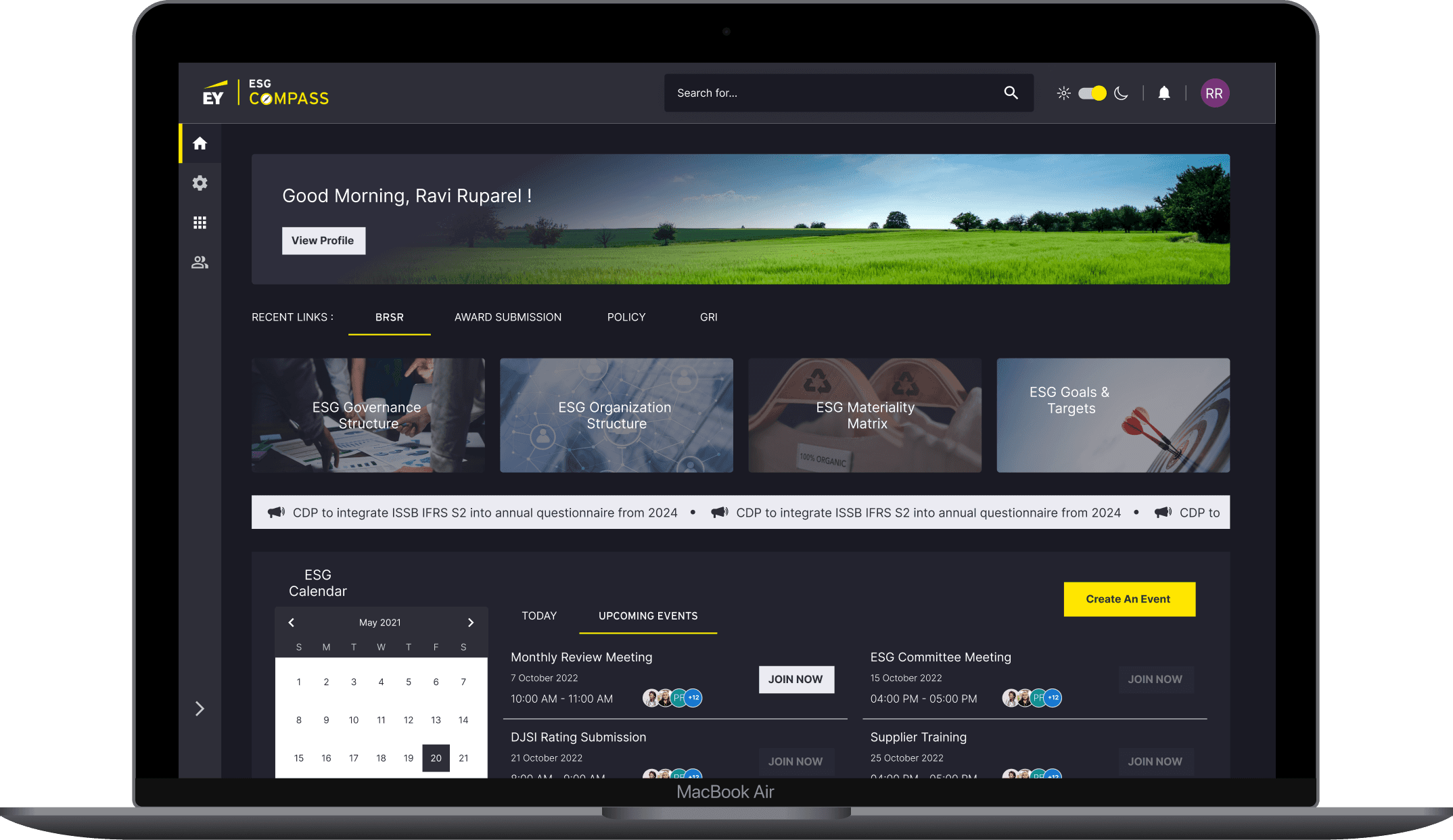
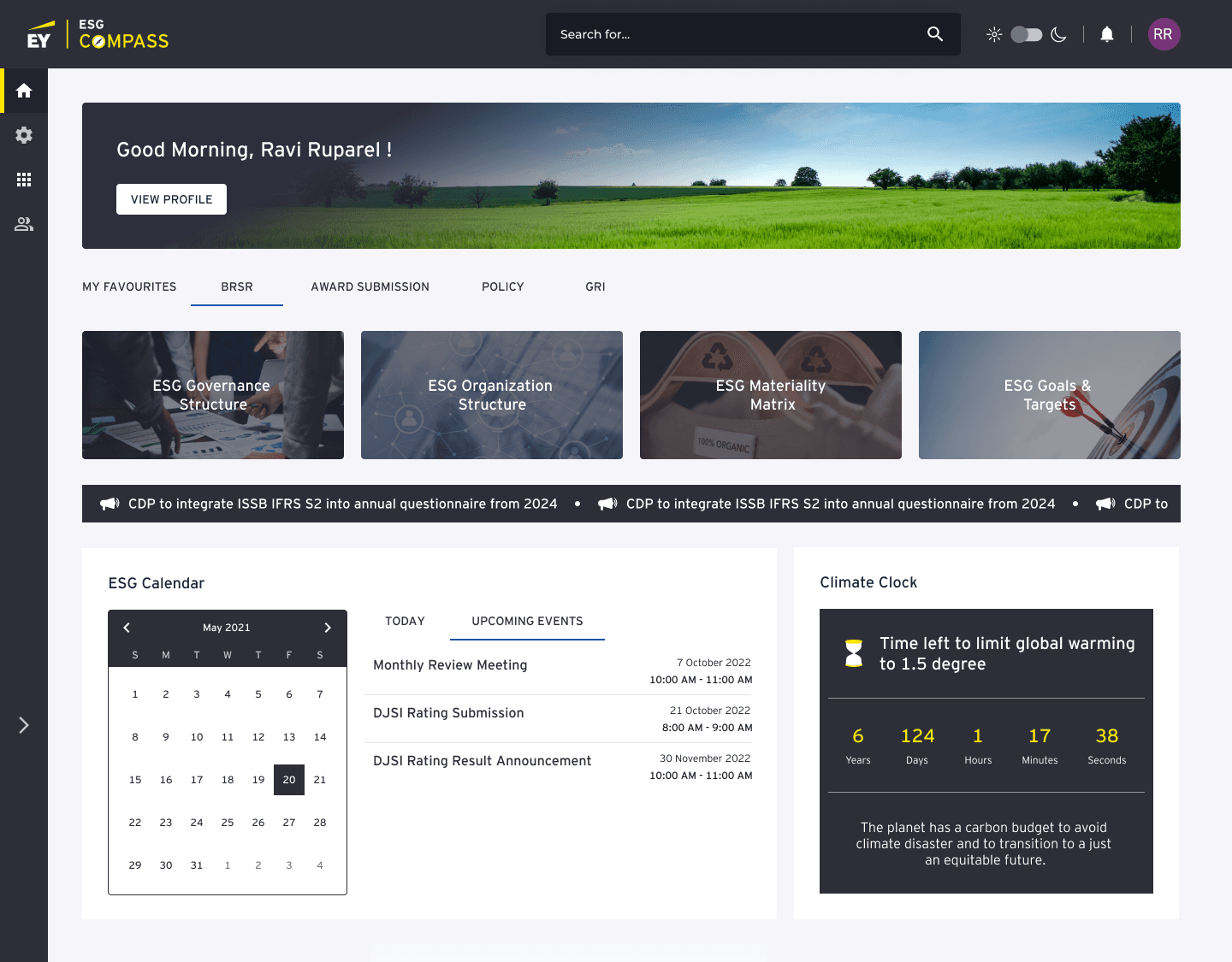
Operational Dashboard
A centralized ESG workspace designed to simplify navigation across reporting, governance, and operational workflows.
Modular ESG navigation
Enterprise-focused information hierarchy
Quick access to recurring workflows
Operational visibility through events & updates
Scalable dashboard structure
Consistent enterprise UI patterns
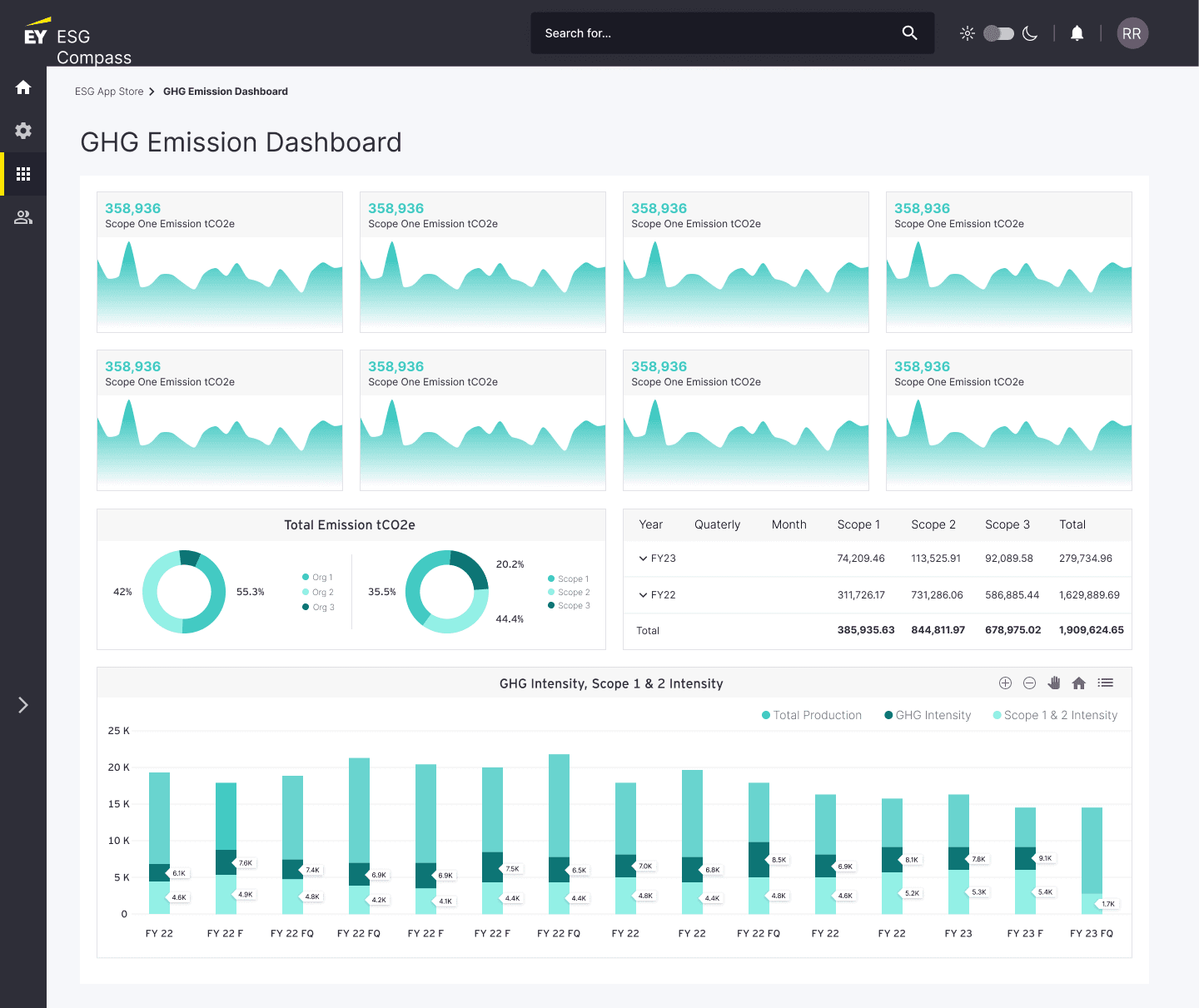
ESG Analytics Dashboard
A centralized analytics experience designed to help enterprise teams monitor emissions, track ESG performance, and interpret large-scale sustainability data through structured visual reporting.
Multi-layered ESG data visualization
Scanable KPI and analytics hierarchy
Comparative emissions tracking across categories
Structured chart and table integration
Designed for high-density enterprise data
Reusable analytics components and layouts
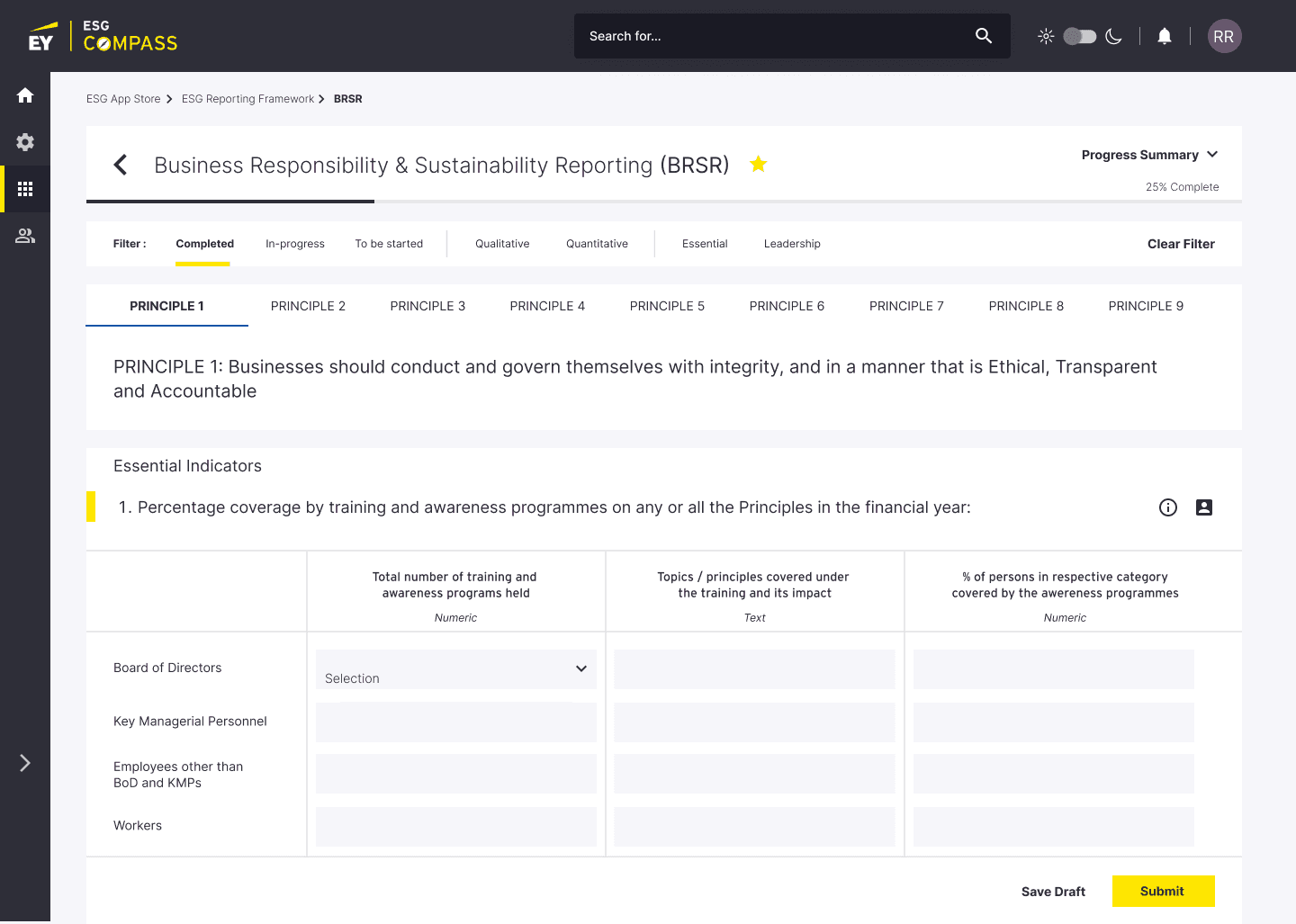
BRSR Reporting Workflow
A structured reporting workflow designed to simplify large-scale ESG disclosures, operational submissions, and compliance-heavy reporting processes within a centralized enterprise system.
Simplified long-form reporting workflows
Structured information architecture for dense forms
Section-based reporting hierarchy
Reusable enterprise form and table patterns
Designed for operational clarity and compliance workflows
Progressive reporting flow with draft and submission states
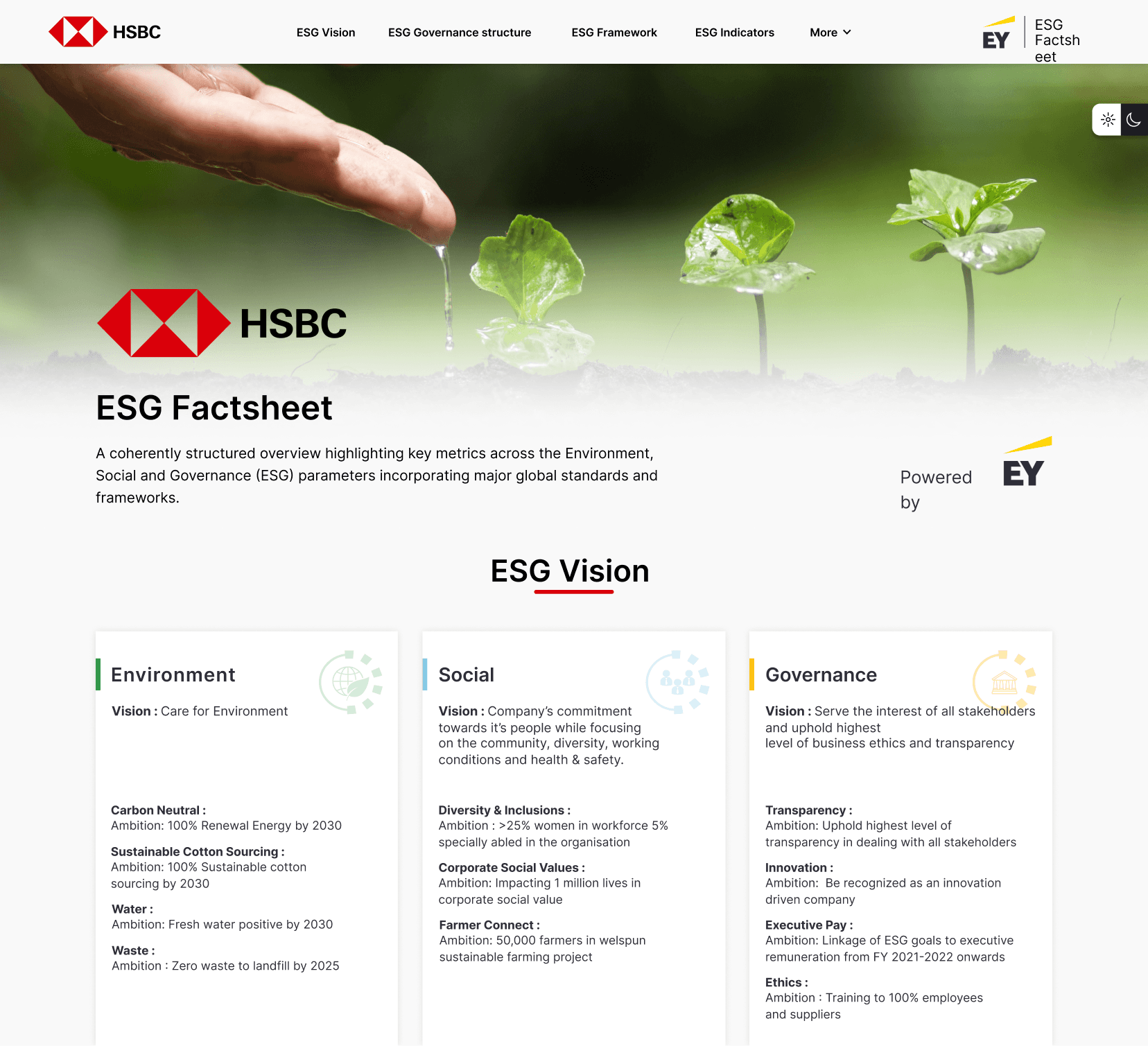
ESG Factsheet Experience
A public-facing ESG reporting experience designed to translate complex sustainability data into structured, accessible, and stakeholder-friendly communication.
Converted operational ESG data into public-facing reporting experiences
Structured information for readability and transparency
Balanced storytelling with enterprise reporting requirements
Designed reusable content-driven layouts for multiple organizations
Simplified navigation across ESG categories and frameworks
Supported scalable factsheet generation for enterprise clients
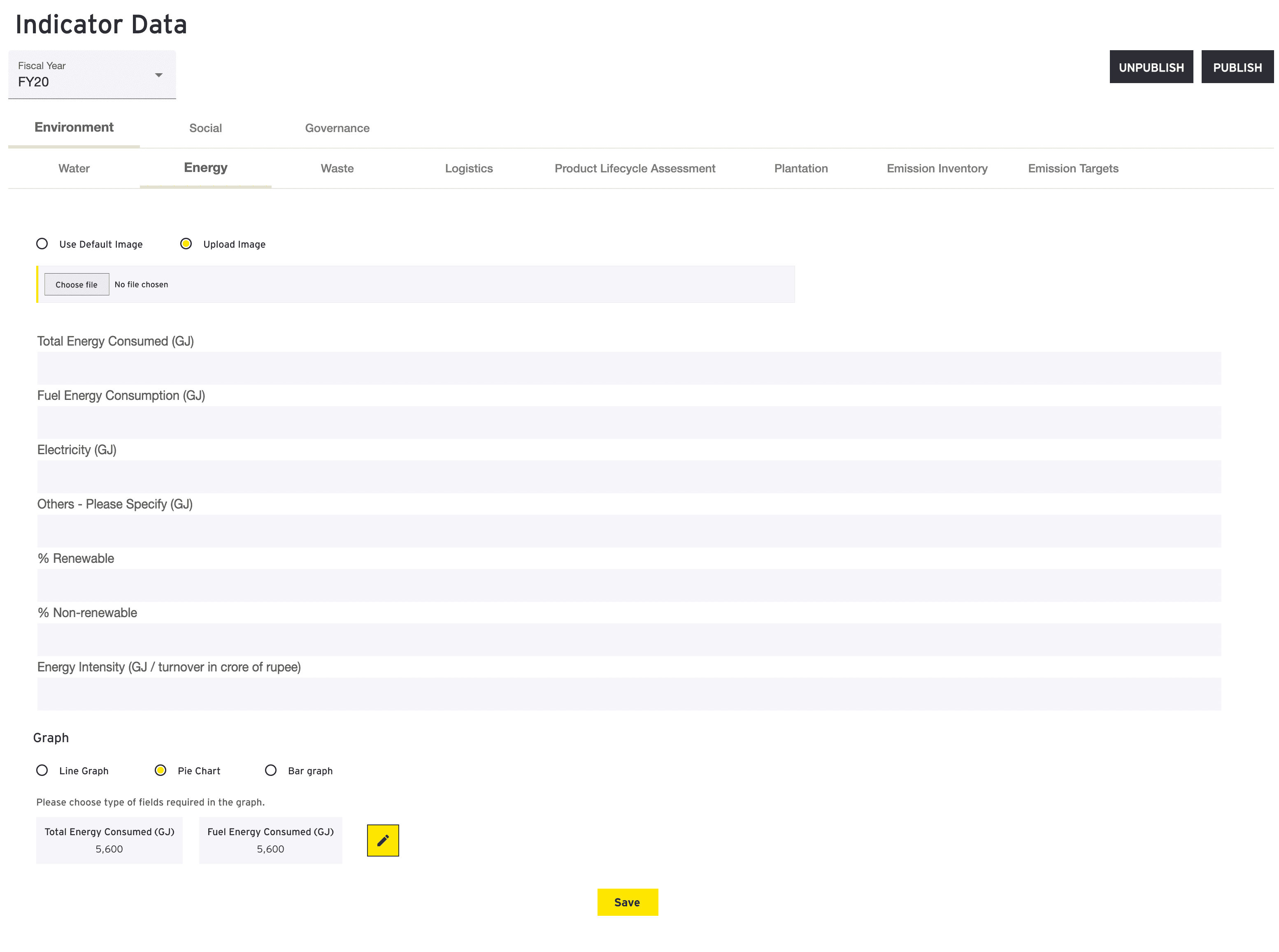
Backend & Data Management
An administrative workflow designed to help enterprise teams manage ESG indicators, configure reporting structures, and maintain operational data across the platform.
Structured backend workflows for ESG data management
Simplified handling of complex operational datasets
Reusable admin forms and configuration patterns
Modular setup for indicators, categories, and reporting structures
Designed for scalability across enterprise ESG workflows
Connected backend management with frontend reporting experiences
Impact
ESG Compass evolved into a modular ESG ecosystem supporting analytics, governance, reporting, operational workflows, and external sustainability communication.
The project helped establish:
Collaboration & Implementation
The project involved continuous collaboration across multiple teams and sprint cycles. Since formal developer handoff systems were still evolving during the project, collaboration with frontend teams happened directly through iterative implementation reviews and QA refinement cycles.
Process Timeline
Stakeholder Discussions
↓
BRD Review
Low Fidelity Exploration
↓
UI & Workflow Design
Frontend Collaboration
↓
QA Validation
Iteration Cycles
↓
Customer Refinements
The experience strengthened my understanding of designing enterprise systems that evolve continuously through collaboration, implementation feedback, and stakeholder iteration.
Learnings
This project fundamentally shaped how I think about enterprise UX. Rather than designing isolated screens, I learned how to design systems that support multiple stakeholders, evolving workflows, and long-term scalability.
Complexity Simplification
A major challenge was simplifying dense ESG workflows and analytics into scalable enterprise experiences. The key was breaking down complex requirements into modular, reusable patterns that could adapt as the platform evolved.
Systems Thinking
The platform evolved into a modular ecosystem connecting analytics, governance, reporting, and public-facing ESG communication. Designing for this required thinking beyond individual features to understand how modules interconnected across the entire enterprise workflow.
Cross-functional Collaboration
I worked closely with QA, frontend, backend, UX, and stakeholder teams through multiple implementation and refinement cycles. The absence of formal handoff systems meant continuous direct collaboration became essential for maintaining alignment.
Iterative Product Thinking
The platform continuously evolved based on stakeholder feedback, implementation realities, and customer onboarding requirements. This reinforced the importance of designing flexible systems that could adapt to changing enterprise needs without requiring complete redesigns.
Working across dashboards, governance systems, analytics, backend tooling, and public ESG communication reinforced the importance of modular thinking, cross-functional collaboration, and designing for long-term scalability.